
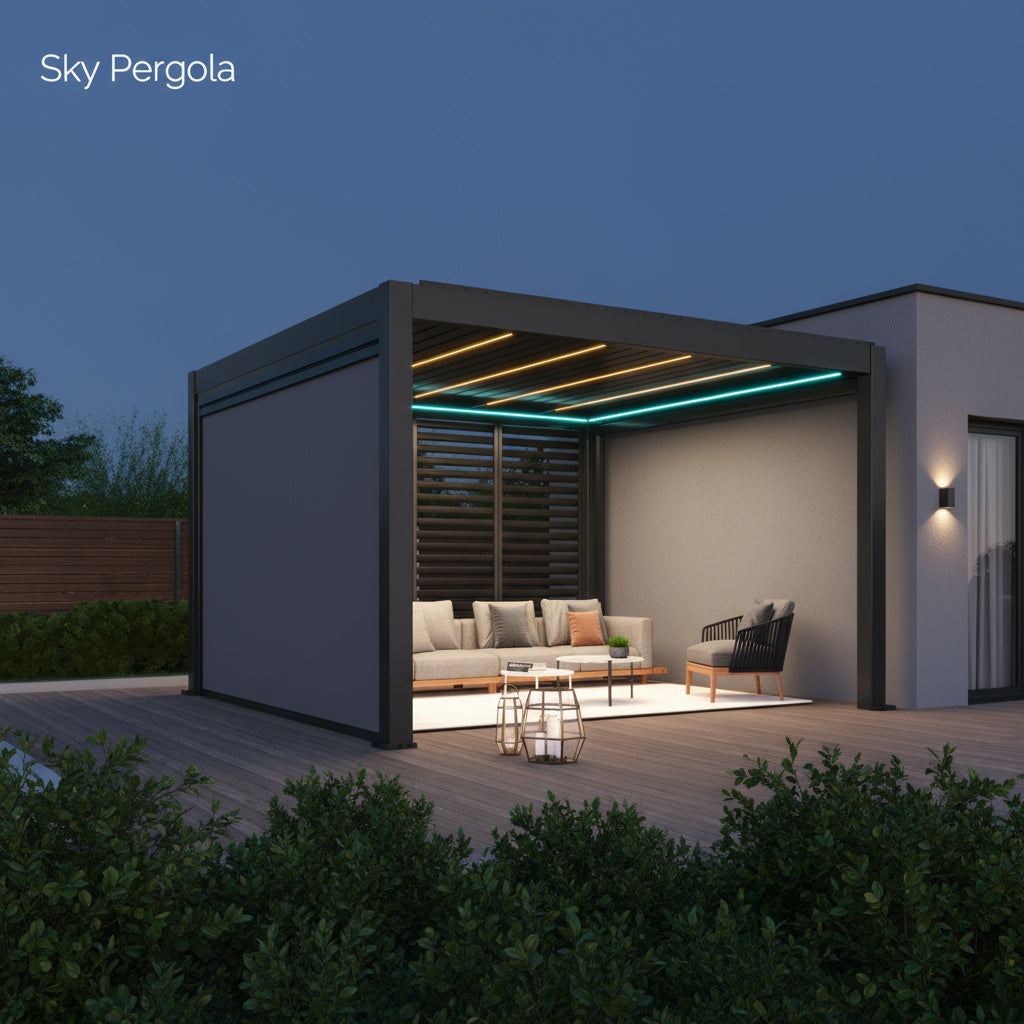
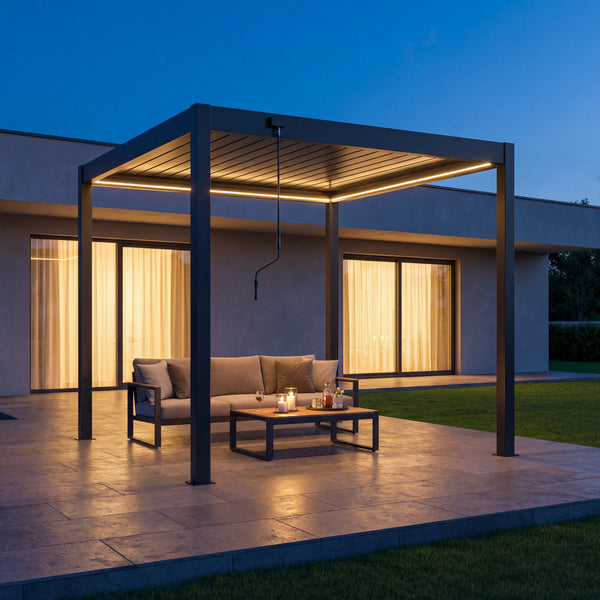
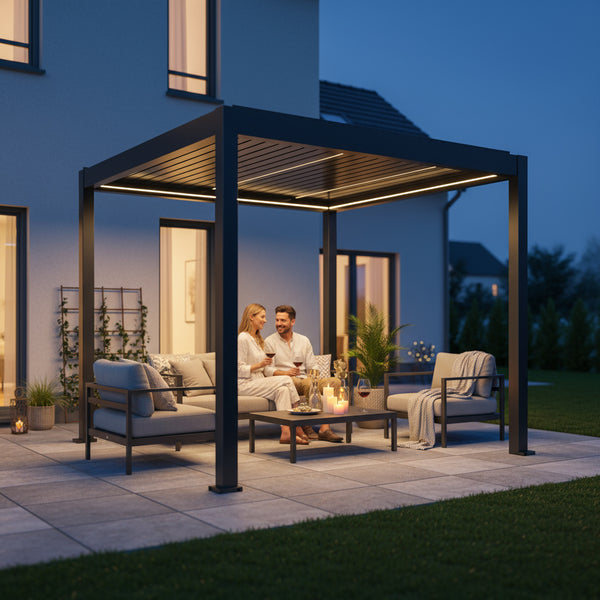
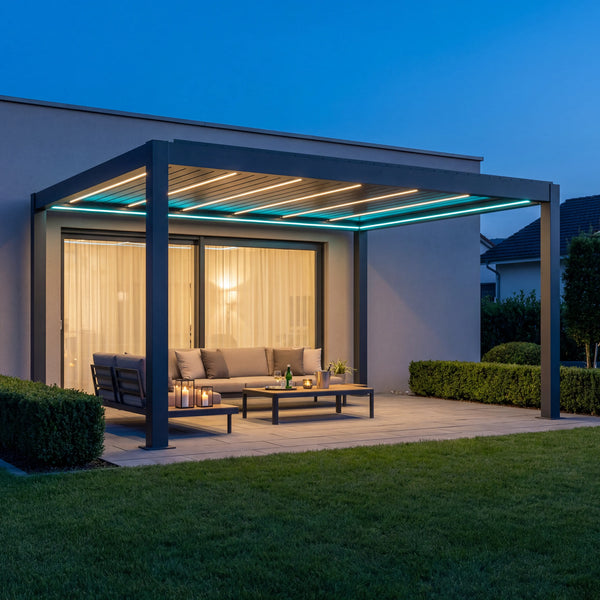






Pergola blinds tend to come up only after the roof is already up: the first comfortable afternoon of the cool season arrives, the louvres are closed, and the sun still comes in sideways under the beam at four o'clock. At that point the useful question is no longer whether you want blinds for pergola sides at all, but which sides need them, how open the fabric should be, and how you run them day to day.
This guide is built around that decision. It uses compass direction as the deciding factor rather than a catalogue of blind types, because on a typical Dubai plot one or two sides do nearly all the work and the rest are better left open. It also covers what product pages tend to skip: what an openness factor of roughly 5 % or 10 % actually changes for your view, the breeze and residual glare, how the roof angle and a single lowered screen act as one control system, how privacy reverses after sunset once your lighting is on, and what routine dust, cool-season showers and the afternoon sea breeze do to fabric and hardware.
None of this replaces a look at your own plot: beam height, boundary walls and neighbouring buildings decide more than any rule of thumb, so measure your sides and note where the low sun lands before you order anything.
Key takeaways
- A louvre roof shades from above. It stops working once the sun drops below the beam line, which is why the west and south-west sides usually earn a vertical screen and a north-facing side usually does not.
- Openness is a view-and-airflow choice, not a glare fix: a direct visible light transmittance above 3 % is already too high for a good glare-control class [1], so expect a 5 % or 10 % mesh to soften low sun rather than remove it.
- Privacy reverses after dark. The same open-weave screen that shields you at midday shows silhouettes as soon as the pergola lighting is on, so plan lighting and fabric density together.
- Routine dust matters more than sandstorms: at Abu Dhabi airport dust storms averaged four days per year while haze occurred on an average of 242 days per year [2], and particles under 0.08 mm count as dust [3], and an open weave does not stop them.
- Rain and wind arrive in the season you actually use the terrace: about 85.5 mm of Dubai's roughly 93.8 mm annual rainfall falls from November to March [4], and a sea breeze occurs more than 77 % of the time in every month of the year on the Gulf coast [5].
- Screening all four sides turns a ventilated outdoor room into a still box. Two sides is usually the sensible answer; if you want a genuinely sealed, air-conditioned space, glazed sides are the better product.
Why a louvred roof still lets the afternoon in
Overhead shade has a geometric limit
A louvre roof is a horizontal shading device, and that is both its strength and its boundary. When the sun is high it performs beautifully: closed or part-closed blades intercept radiation before it reaches the floor, and because the blades tilt you keep air moving upward instead of trapping it, which is the whole point of motorised bioclimatic louvre roofs in Dubai. As the sun drops, the geometry turns against the roof. The lower the sun, the flatter its path under the beam line, until there is simply nothing left above you to intercept it. UN-Habitat's shading guidance, written for the tropics, states the same limit plainly: windows should ideally be shaded during all daylight hours, but doing so would result in impractical overhang and fin designs, especially in the early morning and late afternoon hours when the sun is low in the sky [6].
In Dubai that limit bites in exactly the months you want to be outdoors. Mean daily maximum temperature is 24.0 °C in January and 26.2 °C in December, against 40.6 °C in July and 40.4 °C in August (WMO climate normals 1974–1991) [7]. The cool season is the part of the year when a terrace is usable from late morning to late evening, and it is also the season in which the sun's whole arc sits lower. A roof that was more than sufficient in June can leave a bright band of sun lying across half your seating group in January.
That band is not only a comfort problem. The World Health Organization names shade, clothing and hats as the best protection, notes that up to 80 % of solar UV radiation can penetrate light cloud cover, and adds that haze in the atmosphere can even increase UV exposure [8]. That last point matters on the Gulf coast, where a hazy afternoon does not feel strong. Protection is considered necessary above a UV Index of 3, and the message is reinforced at values of 8 and above [9].
A side blind is the vertical half of the same job
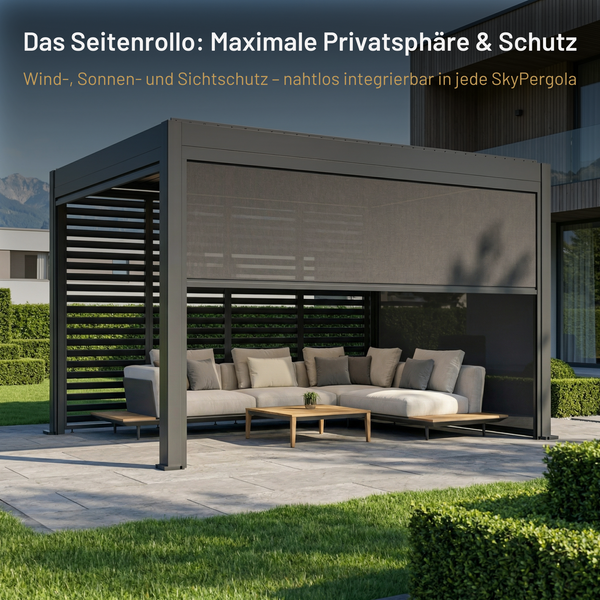
UN-Habitat's worked guidance recommends, for hot climates, orienting the building along the east-west axis with the long façades facing north and south; and where an opening does face west, complete shading needs a horizontal overhang combined with vertical side fins rather than a horizontal device on its own [10]. Those worked examples are calculated for tropical latitudes, so treat the numbers as a principle rather than a specification for a plot at Dubai's latitude. The principle itself is precisely what a side screen delivers: a Sky Pergola Side Blind is a vertical shading element you can put away again when you do not need it, which suits a climate with a long low-sun shoulder far better than a fixed fin would.
So the honest framing is simple. The roof handles the sun above you; the sides handle the sun beside you. Everything that follows is about which beside.
The compass rule: which sides need pergola blinds in Dubai
Side screens on a louvre pergola are chosen side by side, not as a set, so instead of asking how many you can afford, order the four sides by what actually arrives at each of them during the hours you use the space. On a typical Dubai plot the ranking is stable, and it rarely ends with four screens. One note on vocabulary before the compass: the term zip screen describes how the fabric is guided, in lateral guide rails, rather than a different kind of shade.
West and south-west: the sides that usually justify the spend
These are the sides where low sun arrives under the beam, at seated eye height, during the hours when people are outside. The effect is glare as much as heat: you are looking into the source rather than at a lit surface. If you only ever buy one screen, this is where it goes.
Dust is the second argument, but it belongs to the southern half of the compass rather than to a west side. Most dust arrives on winds off the inland desert: 95 of 173 recorded dust events and dust storms at Abu Dhabi airport came from the south-east to west-south-west sector, against 42 from west to north-north-west and 36 from north to east-south-east [11]. Read that as a tendency rather than a precise ranking, and as Abu Dhabi data rather than Dubai data. Practically, it means a screen on a south-west side does two jobs at once, and it is the screen that will need cleaning first.
North and north-west: usually leave it open, and if you screen it, screen it for wind
A north-facing side receives little direct low sun, so it is the side that gives you view and air movement for free. It is, however, the wind side on the coast. The sea breeze occurs in all seasons, sets in during the late afternoon and continues through the evening, with a land breeze taking over at night [12]. It is not an occasional event: measured on the southern Gulf coast, sea breezes occurred more than 77 % of the time during all months of the year, with typical wind speeds of 5 to 10 m per second [5]. And because the prevailing wind and the sea breeze are both from the north-west, sea breeze formation increases the daytime surface wind speed rather than cancelling it out [13]. If you screen this side, you are buying shelter, not shade, and that changes which fabric makes sense.
East: optional, and mostly a breakfast question
Low morning sun is the mirror image of the afternoon problem, but it lasts a shorter time and lands when fewer people are seated. Dust also peaks in that window: poor visibility is most likely after sunrise through the morning and early afternoon, with a peak at 10:00 local time [14]. If your terrace is a breakfast and morning-coffee space, an east screen earns its place. If it is an evening space, it rarely does.
South: case by case, and specific to the cool season
In the cool season the sun stays lower and further south through the middle of the day, so a south-facing side that is irrelevant in summer can admit a band of sun under the beam around midday in December and January. Whether it reaches your seating depends on beam height and how deep the covered area is, which is why this one is a measurement rather than a rule. It is also the side that faces the sector most dust comes from [11].
| Side | What arrives there | Default decision | Reason |
|---|---|---|---|
| West / south-west | Low afternoon sun under the beam, at seated eye height | Screen this first | Overhead shading cannot cover low sun angles [6] |
| North / north-west | Breeze and view, little direct low sun | Leave open; screen only for wind shelter | Prevailing wind and sea breeze both from the north-west and add up [13] |
| East | Low morning sun; dust visibility peaks late morning | Optional, depends on morning use | Dust peak at 10:00 local time [14] |
| South / south-east | Midday sun under the beam in the cool season; wind off the inland desert | Case by case, measure first | Cool-season sun arc sits lower; most dust events and dust storms came from the south-east to west-south-west sector [11] |
| House wall or boundary wall | Nothing; already shaded and screened | No screen | The wall is doing the job |
Openness factor in plain terms: what 5 % and 10 % change
The openness factor is nothing more exotic than the ratio between the area of the openings and the total area of the fabric. A 10 % fabric has twice as much hole as a 5 % fabric. What is almost never explained is which of the three things you care about — outward view, air through the weave, and residual glare — each number actually moves.
Glare is a transmittance question, not an openness question
Industry guidance on BS EN 14501:2021 is blunt about it: a direct visible light transmittance above 3 % is already too high to have a good glare control class [1]. For glare control, BREEAM accepts blinds with an openness factor of 1 % or less combined with a light transmission value below 10 %, or products in class 3 or class 4 of EN 14501 [15]. In other words, a 5 % or 10 % mesh is not a glare solution and was never meant to be one. It is a comfort and view product that takes the heat and the force out of low sun. There is even a measured threshold for when glare becomes a complaint: research behind the daylight standards determined that a Daylight Glare Probability below 35 % is mostly imperceptible, while above 40 % the glare is considered disturbing to occupants [16].
Why the height of the sun changes the answer
Mesh products can still do well on glare if the geometry suits them. Guidance notes that mesh shading products may obtain a higher class where the fabric's cut-off angle is 65° or less, the cut-off angle being the first angle of incidence at which the direct light transmittance is no longer perceivable [17]. Read that the practical way round: the same fabric behaves very differently depending on how square-on the sun is. When the sun is low and shining almost perpendicular into the screen, you are looking straight through the holes, and a more open weave will sparkle. This is worth knowing before you choose between 5 % and 10 % on a west side.
These are European product standards, not Dubai rules
EN 13561 and EN 14501 are European product standards with no legal force in the UAE. They are still the most useful yardstick you have when comparing quotations, because they turn adjectives into classes. EN 14501 classifies solar protection devices for darkening, night privacy, visual contact with the outside, glare control, daylight utilisation and the rendering of colours [18]. Ask a supplier for those six properties rather than for the word premium.
| Fabric choice | View out by day | Air through the weave | Residual glare at low sun | Where it fits |
|---|---|---|---|---|
| Openness about 1 % or less | Limited, surface rather than scene | Minimal | Lowest; this is the glare-control territory [15] | One badly overlooked or badly sun-struck side only |
| Openness about 5 % | Readable view, softened | Noticeable | Reduced but present when the sun is square-on | Default for a west or south-west side |
| Openness about 10 % | Open, close to unobstructed | Clearly higher | Still visible; expect sparkle through the weave | A wind or dust side where you want to keep the view |
Roof angle plus one side down: the roof and the screens as one system
Almost every operating mistake comes from treating the roof and the sides as two separate controls. They are one system, and in Dubai the lowest-effort setting is rarely everything closed.
The cool-season afternoon setting
Louvres nearly closed, one screen down on the west or south-west side, the other sides fully open. You block the sun that the roof cannot reach, and you keep cross-ventilation alive through the two open sides, which is what stops the space feeling stagnant. This is the setting that handles most of November to March.
The evening setting
Once the sun is down, the screen has no shading job left. Raise it unless you are using it for shelter or privacy, open the louvres a little, and let the air through. The sea breeze continues through the evening before a land breeze takes over at night [12], so the breeze you want is usually available precisely then.
The showery-day setting
Louvres fully closed, and a screen down on the windward side only to keep driven rain off the furniture. A closed louvre roof is rainproof and channels water away through the integrated drainage, but it is worth being realistic: with any structure of this kind, extreme weather can still force isolated water ingress. Raise the screen again as soon as the wind freshens — more on the thresholds below.
What not to do
Do not default to four sides closed and the roof shut. You lose the view, you lose the air movement that makes shade feel cool rather than merely dark, and you expose the fabric to UV for hours it did not need to be out. If your real requirement is a sealed room, that is a glazing decision, not a fabric decision.
The privacy inversion after sunset
Every screen is sold on privacy, and by day that claim holds: the bright side is outside, the darker side is in, and an open-weave fabric reads as near-opaque from the street. After sunset the brightness gradient reverses. Your pergola lighting is now the brightest thing on the plot, and a 5 % or 10 % fabric that hid you at two in the afternoon will show your silhouette clearly at eight in the evening. This is not a defect; it is how directional visibility through a mesh works, and it is the reason night privacy is treated as its own classified performance property alongside darkening, visual contact with the outside and glare control [18].
Three things that actually fix it
- Lower the light level, raise the number of sources. Integrated LED in the frame, pointing downward, puts light on the table rather than into the fabric. One bright central source is what creates the silhouette effect.
- Light the house wall, not the screen. Uplight on a solid surface gives you usable brightness without backlighting anybody sitting between the source and the mesh.
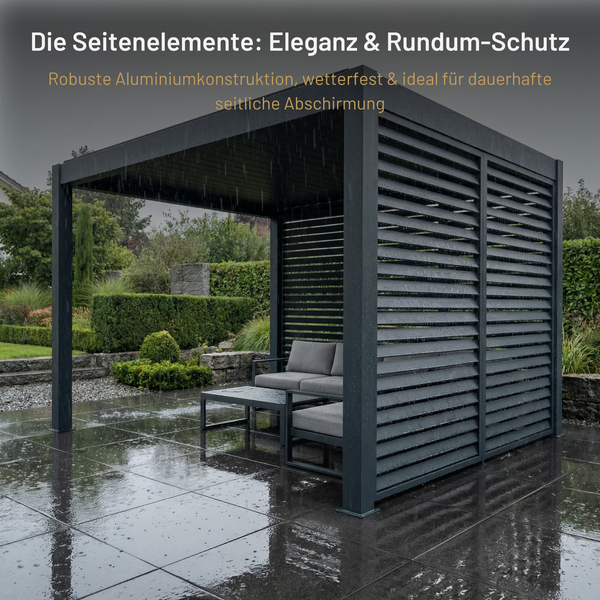
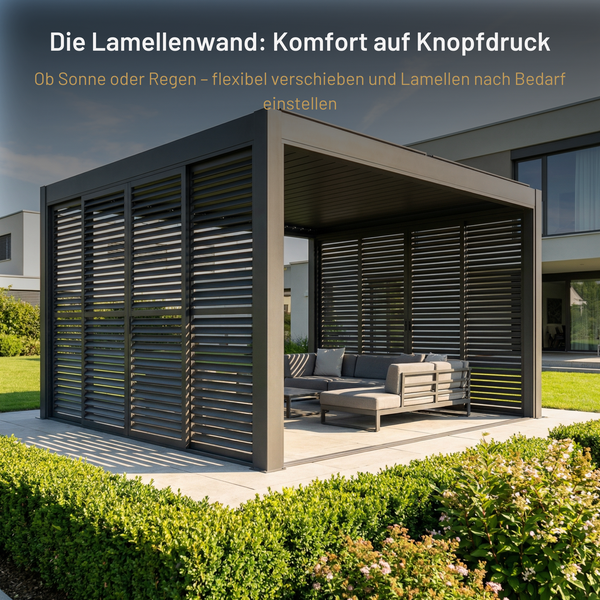
- Change the fabric or the element on the overlooked side only. If one side faces a neighbour's first-floor window or a shared walkway, treat that side differently rather than densifying everything. A Sky Pergola Sliding Louver Wall lets you move the wall and open or close its louvre panels individually, which gives you a privacy setting that a fabric screen cannot; a Sky Pergola Side Element is a fixed aluminium louvre wall that also provides reliable protection from rain on that side.
Dust, sand and what collects at the bottom
What actually settles on a screen
The sales version of this topic is that a guided screen seals the perimeter and keeps sandstorms out. The measured version is more useful. The diameter of grains of desert sand usually varies from 0.15 mm to 0.3 mm, with a lower limit of 0.08 mm, and anything below 0.08 mm is defined as dust [3]. An open weave with 5 % or 10 % of its area as holes does not stop particles of that size. A screen reduces what reaches your furniture; it does not make the space dust-tight, and any supplier who promises that is overselling.
The second correction is about frequency. Full dust storms are not the maintenance driver: at Abu Dhabi airport dust storms averaged four days per year with a maximum of seven in 1994, while haze, partly caused by dust, occurred on an average of 242 days per year [2]. You are maintaining against a near-permanent fine haze, not against a handful of dramatic events.
Sand behaves differently from dust, and that explains what you find at the bottom of a screen. Surface turbulence is normally too weak to raise grains of sand more than about a metre above the ground until the wind speed at 10 m reaches 20 knots, and the sand falls quickly back to the ground when the wind drops [19]. So a gusty hour leaves grit in the bottom bar and, where a screen's fabric runs in lateral guide rails, in the lower part of those rails rather than a lasting haze in the air. A handy field cue: above 15 knots visibility can fall below 8000 m and is often less than 5000 m, and above 20 knots it is often below 2000 m [20]. If the skyline has visibly gone soft, the wind is probably already in the range that moves sand.
A care routine that fits Dubai conditions
- Weekly, dry first. Brush or vacuum the fabric and the bottom bar while dry, from top to bottom. Never hose a dusty screen first; water turns the fine fraction into mud and drives it into the weave.
- Weekly, the guidance. If your screen runs in lateral guide rails — ask your supplier, and see the checklist below — run it fully up and blow or vacuum the channels out. Grit in a rail is what causes a fabric edge to wear and the drive to labour.
- Monthly, wet. Rinse with clean water and a soft sponge, no abrasive pads and no stiff brushes on coated surfaces. Work with the weave, not across it.
- Monthly, check. Look at the bottom bar seating, the fabric edges, and the fixings. Report anything that has started to catch rather than forcing it.
- Each season, before and after. One deeper clean at the start of the cool season and one at the end, plus a look at the coating on the posts and rails near the ground, which is where splash and grit meet.
On material durability, it is worth asking for the right evidence. EN 13561 normatively references salt-spray corrosion testing to ISO 9227 for metal parts and xenon-arc artificial weathering to EN ISO 105-B04 for colour fastness of the fabric [21] — the two ageing mechanisms that dominate a coastal, high-UV site. On the fabric itself, laboratory work on uncoated polyester fabrics found that the most influential mechanism on tensile strength degradation under combined heat, humidity and UV was chain scission caused by photodegradation, while water cycles at temperatures below the glass transition temperature had no measurable impact on strength [22]. That is a mechanism, not a service life: UV is the thing that ages your screen, and unnecessary hours deployed are the cost you control.
Seven operating mistakes that shorten a blind's life
- Leaving the fabric down permanently, which buys UV hours you did not need and removes the view you paid for.
- Rolling up damp fabric after a shower instead of letting it dry fully on the rail.
- Hosing a dry, dusty screen and smearing the fine fraction through the weave.
- Running a guided screen while there is still grit in its guide channels.
- Scrubbing coated aluminium with abrasive pads, which grinds sand into the finish.
- Screening all four sides and losing cross-ventilation entirely.
- Leaving a screen down when the breeze freshens because it was convenient.
Rain and wind in the cool season: when to raise pergola blinds in the UAE
Rain arrives exactly when you are outside
Dubai's rainfall is concentrated in the months a pergola is in daily use. On the same 1974–1991 normals, mean monthly rainfall runs 11.3 mm in January, 35.7 mm in February and 22.4 mm in March, with 1.8 mm in November and 14.3 mm in December, while June through October each show 0.0 mm [4]. Roughly 85.5 mm of the approximately 93.8 mm annual total therefore falls between November and March [4]. Planning side screens as a summer accessory gets the season wrong.
Two practical consequences follow. First, splash-back: rain hitting a hard terrace surface bounces, and the bottom 20 to 30 cm of a screen gets wet from the inside as well as the outside. If a side regularly takes driven rain, think about what is standing within that band — cushions, a rug, a speaker on the floor. Second, drying: fabric rolled up damp stays damp in the cassette. Let it dry fully on the rail before you retract it.
Wind: the number you should insist on in writing
Vague advice to retract in strong wind is useless because every product has a different limit, and the standard says as much: the manufacturer shall define a maximum speed above which the external blind shall be retracted, and this wind speed shall be indicated in the instructions for use [23]. Ask for that figure before you buy, and set your own habit around it rather than around how the evening feels.
It also helps to understand what a wind class does and does not claim. EN 13561 specifies wind resistance in seven classes, 0 to 6, through threshold values of nominal pressure, with the safety pressure set at 1.2 times the nominal value, and the nominal pressures running from under 40 N/m² up to 400 N/m² [24]. Classes 4 to 6 are only allowed for external blinds with fabric running in lateral guide rails and for pergola awnings, while a folding-arm awning may not exceed class 2 [25] — which is the standard's own ranking of a guided side screen against a conventional awning, and the reason the extra classes were introduced for products with a higher wind resistance than before [26].
Two caveats keep that from being oversold. The standard notes that the performance requirement is based on static loads and does not consider the dynamic effect of repeated loads and turbulence, so the static pressure cannot be used to define the anchoring of the external blind on the building [27]. And EN 13561 explicitly covers pergola awnings as a product family while stating that the structural part to which the pergola awning is fixed is not covered [28]. A screen's class tells you about the screen. The frame and how it is fixed into your slab or parapet are a separate question, and a fabric class does not answer it.
Side plans for the three most common villa situations
Terrace against the house wall
One side is already solved: the wall shades it, screens it and takes no maintenance. That usually leaves three open sides, of which one — the west or south-west — carries the real load. Screen that one, leave the side that faces the breeze open, and treat the third as optional depending on whether you use the space in the morning. A common error here is screening the side nearest the garden gate for privacy when the actual exposure is one floor up on a neighbouring villa; check sightlines at the height they come from.
Free-standing garden pergola
All four sides are exposed, which tempts people into a full enclosure. Resist it. Screen the afternoon-sun side, decide the morning side on use, and keep the north-west side open so the sea breeze, which occurs in all seasons on this coast [12], still reaches you. A free-standing structure also has no wall to light against in the evening, which makes the night-privacy question sharper: plan downward lighting from the start.
Pergola along a boundary wall
A boundary wall already blocks low sun on that side and already handles privacy up to its own height, so a screen there is usually redundant. The useful question is the reverse one: a wall close to the pergola can block airflow and hold warm air under the roof, so keep the two sides perpendicular to it open and use the roof angle to vent upward rather than closing everything.
When fabric is the wrong answer
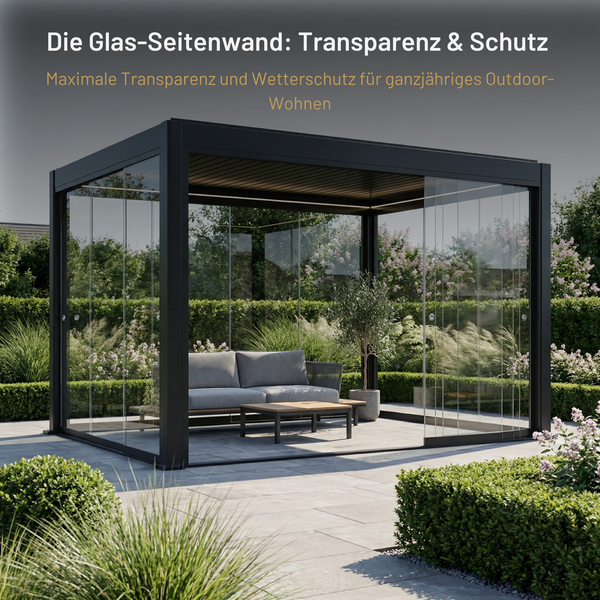
Textile screens are the right level of intervention when you want adjustable, retractable protection on one or two sides and you want the space to stay ventilated. They are the wrong answer when you want a sealed room. If you are aiming at year-round, air-conditioned use, at keeping fine dust off electronics and upholstery, or at a wind-exposed corner site where you would otherwise be raising screens constantly, glazing is the honest choice. A Sky Pergola Glass Side Wall slides in 10 mm safety glass and keeps the view while enclosing the side; the broader options and combinations are set out on the glass pergola Dubai page with sliding glass walls. A mixed configuration is possible: glass on the side that needs enclosure, fabric on the side that only needs the afternoon handled.
Sky Pergola side options, and what to have ready before you ask for a quotation
Side elements are chosen per side, not per pergola, which is why a sensible configuration often combines two different products. Entry prices below are the starting points for the UAE market.
| Element | What it does | Entry price |
|---|---|---|
| Side blind | Retractable fabric screen in weather-resistant material, for protection from wind, weather and unwanted views | from AED 5,175 |
| Side element | Fixed aluminium louvre wall, provides reliable protection from rain | from AED 8,505 |
| Glass side wall | Sliding wall in 10 mm safety glass, maximum transparency | from AED 9,405 |
| Sliding louver wall | Movable wall whose louvre panels can be opened or closed individually | from AED 11,205 |
On the roof side, two models in the range are described as configurable with blinds, side elements and glass. The SkyPergola SkyLite ECO aluminium pergola is a 3 x 3 m structure with integrated LED lighting and a manual louvred roof, from AED 21,555, and the SkyPergola SkyMotion LED aluminium pergola is a 3 x 3 m structure with integrated LED and a motorised louvred roof, from AED 28,755. Both are powder-coated, rainproof and drain through the posts, louvres and gutters. At the top of the range, the SkyGrand Master's description also lists motorised blind systems among its optional additions. Posts, beams and louvres share the same colour, and the motor sits out of sight in the beam.
The short list to prepare
- A plan sketch with the clear width of each side, and which compass direction each side faces.
- Where the low sun actually lands during the hours you use the space, noted on two or three different afternoons.
- What the terrace surface is at the foot of each side, because that governs splash-back.
- What overlooks the space, and at what height — ground level, first floor, or a shared walkway.
- Your lighting intention, since it determines the night-privacy answer.
- Whether you want a ventilated outdoor room or a sealed one. This single answer decides fabric versus glass.
- Ask any supplier what they can document: the fabric openness factor, the glare and night-privacy classes of EN 14501 [18] if the product is classified at all, whether the fabric runs in lateral guide rails and what wind class that allows [25], and the maximum wind speed above which the blind must be retracted [23]. Not every product on the market carries an EN classification; what matters is that the figures a supplier does have reach you in writing.
Conclusion: screen two sides well rather than four badly
If you take one thing from this guide, make it the compass rule. The roof deals with the sun above you and runs out of geometry as the sun drops [6] — a limit stated in guidance written for tropical climates, but a purely geometric one — so the vertical screen belongs on the west or south-west side first. Dust is a separate argument that points slightly differently: most dust events and dust storms recorded at Abu Dhabi airport came from the south-east to west-south-west sector [11]. Leave the north-west side open for the breeze, which occurs more than 77 % of the time in every month of the year on the Gulf coast [5], and treat east and south as measured decisions rather than defaults.
Then choose the fabric for the right reason. A 5 % or 10 % openness is a view-and-airflow choice; glare control lives at much lower transmittance values [1], and if you need a sealed, conditioned space you need glass, not mesh. Run the screens in short, deliberate stints, keep any guide channels free of grit, let the fabric dry before you roll it up, and raise it when the breeze freshens rather than after something has moved.
When you know which sides you want and roughly how open you want them, put the configuration together in the Sky Pergola configurator and send us your side plan with the orientation of each side when you ask for a quotation.
Frequently asked questions
Which sides of a pergola actually need blinds — do I have to screen all four?
No. On a typical Dubai plot one or two sides carry the whole problem. Start with the west or south-west side: overhead shading cannot cover low sun angles [6] and would need impractical dimensions to try, a limit stated in guidance written for tropical climates but geometric in nature. Leave the north-west side open for the sea breeze, which occurs more than 77 % of the time in every month of the year on the Gulf coast [5] and costs you nothing. Screening all four sides removes the cross-ventilation that makes shade feel cool.
What openness should I pick in Dubai — 5 % or 10 %?
Treat it as a view-and-airflow decision. The openness factor is simply the ratio between the area of the openings and the total fabric area. Neither value is a glare solution, because a direct visible light transmittance above 3 % is already too high for a good glare-control class [1] and glare control sits at far lower values. Choose about 5 % for a west side where you want the sun's force taken out, and about 10 % where keeping the view and the breeze matters more.
Can people see in at night when the lights are on behind the blinds?
Yes, and this is the part nobody mentions. By day the bright side is outside and an open weave reads as near-opaque. After sunset your lighting is the brightest thing present, so a 5 % or 10 % fabric shows silhouettes. Night privacy is a formally classified property [18] alongside glare control and visual contact with the outside. Fix it with lower, downward light, uplight on a solid wall, or a denser element on the overlooked side only.
Do pergola blinds keep out rain, or just take the force out of it?
They take the force out of it. A screen on the windward side keeps driven rain off furniture, but rain striking a hard terrace splashes back and wets the lowest band of the fabric from inside. This matters because Dubai's rain falls in the season you use the terrace: about 85.5 mm of the roughly 93.8 mm annual total comes between November and March, with 35.7 mm in February alone, on the WMO normals for 1974 to 1991 [4]. Let the fabric dry fully before rolling it up.
At what wind speed do I have to roll pergola blinds up?
At the speed your own product documentation states. The European product standard requires the manufacturer to define a maximum speed above which the external blind must be retracted and to state it in the instructions for use [23]. Ask for that figure in writing before you order. As a field cue, sand starts moving along the ground once the wind at 10 m reaches about 20 knots [19] — well past the point for raising a screen.
Will sand and dust jam the side guide rails, and how do I clean them?
Grit does collect in the bottom bar and, where a screen's fabric runs in lateral guide rails, in the lower part of those rails, because sand falls straight back down as soon as the wind drops [19] rather than staying airborne. Clean dry first: brush or vacuum the fabric, then blow or vacuum any channels out with the screen fully raised. Only then rinse with clean water and a soft sponge. Hosing a dusty screen drives the fine fraction into the weave, and running a guided blind with grit in the channels wears the fabric edge.
Should I choose glass side panels instead of fabric blinds — and when is glass better?
Fabric is right when you want adjustable, retractable protection on one or two sides and a space that stays ventilated. Glass is right when you want a sealed room: year-round air-conditioned use, keeping fine dust off upholstery and electronics, or a wind-exposed corner where you would otherwise raise screens constantly. Note that particles under 0.08 mm count as dust [3] and pass through any open weave, so no mesh makes a space dust-tight. Mixed configurations are possible.
Do I need a permit to add side screens to an existing pergola?
We cannot answer that for your plot and will not guess. Ask the authority responsible for your area, and ask your master developer or community management whether an approval or a no-objection certificate is required for adding side elements to an existing structure. Get the answer before you order, and ask which documents they require.
Sources
- Guidance Note L-05: BS EN 14501 Glare Classification – British Blind & Shutter Association (BBSA)
- Dust storms and dust at Abu Dhabi International Airport – University of Pretoria Research Repository (M. P. de Villiers & J. van Heerden)
- Dust storms and dust at Abu Dhabi International Airport – University of Pretoria Research Repository (M. P. de Villiers & J. van Heerden)
- World Weather Information Service – Dubai, United Arab Emirates (climatological information) – World Meteorological Organization (WMO), data supplied by the United Arab Emirates
- A climatological study of the sea and land breezes in the Arabian Gulf region – Journal of Geophysical Research: Atmospheres (American Geophysical Union); copy hosted by North Carolina State University
- Sun Shading Catalogue – Adequate shading: Sizing overhangs and fins – United Nations Human Settlements Programme (UN-Habitat)
- World Weather Information Service – Dubai, United Arab Emirates (climatological information) – World Meteorological Organization (WMO), data supplied by the United Arab Emirates
- Global Solar UV Index: A Practical Guide (WHO/SDE/OEH/02.2) – World Health Organization, with WMO, UNEP and ICNIRP
- Global Solar UV Index: A Practical Guide (WHO/SDE/OEH/02.2) – World Health Organization, with WMO, UNEP and ICNIRP
- Sun Shading Catalogue – Adequate shading: Sizing overhangs and fins – United Nations Human Settlements Programme (UN-Habitat)
- Dust storms and dust at Abu Dhabi International Airport – University of Pretoria Research Repository (M. P. de Villiers & J. van Heerden)
- A climatological study of the sea and land breezes in the Arabian Gulf region – Journal of Geophysical Research: Atmospheres (American Geophysical Union); copy hosted by North Carolina State University
- A climatological study of the sea and land breezes in the Arabian Gulf region – Journal of Geophysical Research: Atmospheres (American Geophysical Union); copy hosted by North Carolina State University
- Dust storms and dust at Abu Dhabi International Airport – University of Pretoria Research Repository (M. P. de Villiers & J. van Heerden)
- Control of glare from sunlight: use of EN 14501 to demonstrate compliance for blinds – BRE Group – BREEAM Knowledge Base
- Guidance Note L-05: BS EN 14501 Glare Classification – British Blind & Shutter Association (BBSA)
- Guidance Note L-05: BS EN 14501 Glare Classification – British Blind & Shutter Association (BBSA)
- EN 14501:2021 – Blinds and shutters. Thermal and visual comfort. Performance characteristics and classification – European Committee for Standardization (CEN), catalogue entry at iTeh Standards
- Dust storms and dust at Abu Dhabi International Airport – University of Pretoria Research Repository (M. P. de Villiers & J. van Heerden)
- Dust storms and dust at Abu Dhabi International Airport – University of Pretoria Research Repository (M. P. de Villiers & J. van Heerden)
- EN 13561:2015 – External blinds and awnings. Performance requirements including safety (preview) – European Committee for Standardization (CEN) / Slovenian Institute for Standardization (SIST)
- Artificial Weathering Mechanisms of Uncoated Structural Polyethylene Terephthalate Fabrics with Focus on Tensile Strength Degradation – Materials (MDPI), via PubMed Central, US National Library of Medicine
- EN 13561:2015 – External blinds and awnings. Performance requirements including safety (preview) – European Committee for Standardization (CEN) / Slovenian Institute for Standardization (SIST)
- EN 13561:2015 – External blinds and awnings. Performance requirements including safety (preview) – European Committee for Standardization (CEN) / Slovenian Institute for Standardization (SIST)
- EN 13561:2015 – External blinds and awnings. Performance requirements including safety (preview) – European Committee for Standardization (CEN) / Slovenian Institute for Standardization (SIST)
- Commission Delegated Regulation on external blinds and awnings and their performance requirements, including safety, under EN 13561 (draft, AG 005-02.4) – European Commission (document published for consultation by the Norwegian Building Authority, DiBK)
- EN 13561:2015 – External blinds and awnings. Performance requirements including safety (preview) – European Committee for Standardization (CEN) / Slovenian Institute for Standardization (SIST)
- EN 13561:2015 – External blinds and awnings. Performance requirements including safety (preview) – European Committee for Standardization (CEN) / Slovenian Institute for Standardization (SIST)
Last updated: November 2026


