





Play equipment in the garden is almost always planned according to stability, fall protection and material. Shade is missing from this list, even though it determines how many hours a day the area is actually usable. Anyone looking at a heated sandbox at half past twelve in July faces the problem: The equipment is there, but no one plays on it.
When the play area becomes unusable
Between eleven and sixteen o'clock in midsummer, the sun in the Swiss Plateau is so high that vertical elements hardly cast any shadow. A hedge that covers half the sandbox at nine o'clock casts only a narrow strip at its base at noon. At the same time, surfaces that lay in the sun all morning heat up:
- Sand in an open box reaches over 50 degrees on the surface on clear days.
- Metal parts on slides and climbing frames become hot enough that children avoid them.
- Plastics age faster under UV exposure and become brittle, especially on ropes and connectors.
The result is not a catastrophe, but a quiet shift: play happens in the morning and evening, and midday is skipped. Exactly when parents have time in the garden.
Why sun sails often don't hold up
The obvious solution is a sail. It is inexpensive, quickly installed and available in any colour. In practice, it fails on two points. First, tension: A sail must be taut, otherwise water collects in the dip, and the load on the corners increases many times within minutes. Second, the wind. A gust of 60 km/h generates forces on an area of twenty square metres that can lever out a ground sleeve set in the lawn.
Therefore, sails must be taken down as soon as wind is forecast — and this does not happen in everyday life. What remains is a textile that hangs faded after two summers, and a post that has tilted.
What a fixed roof does differently
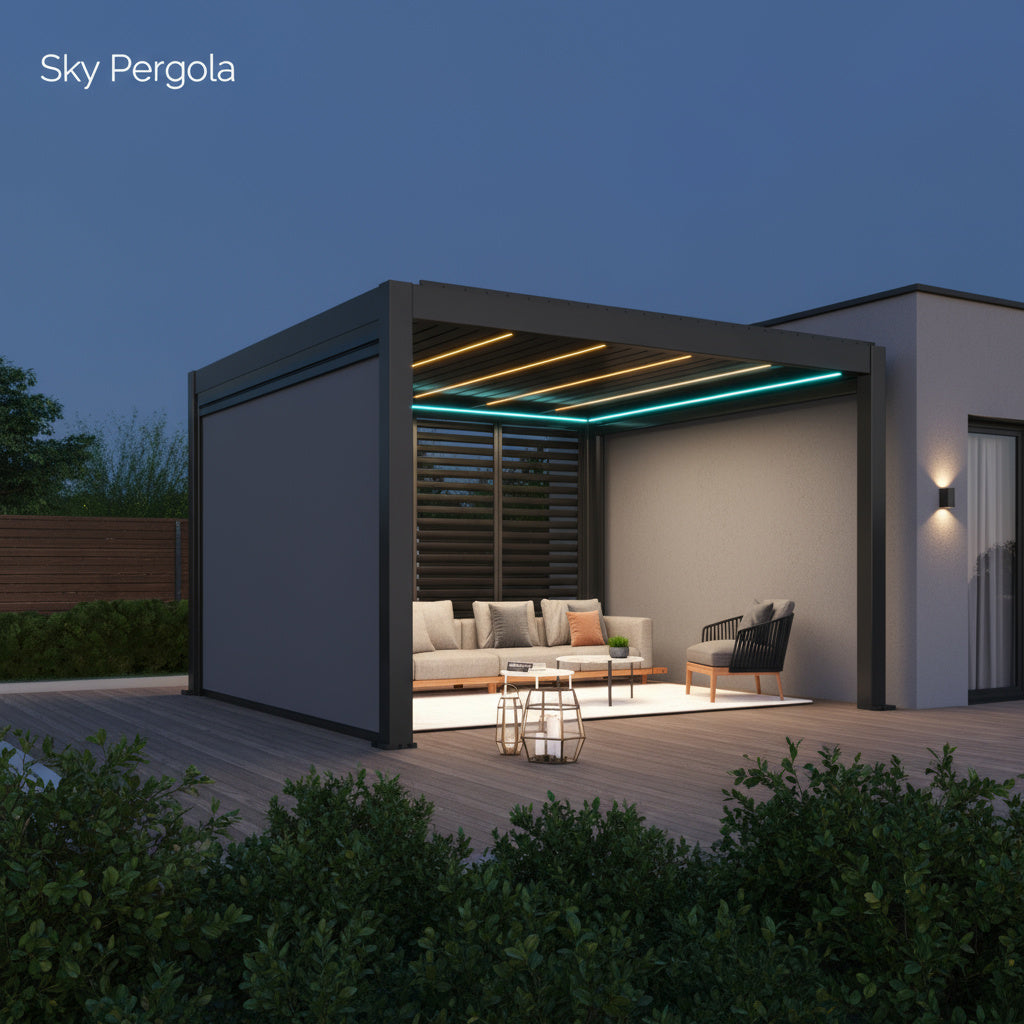
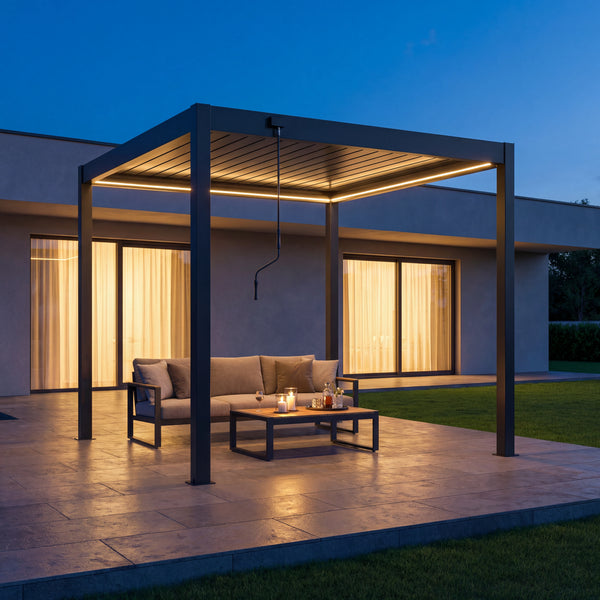
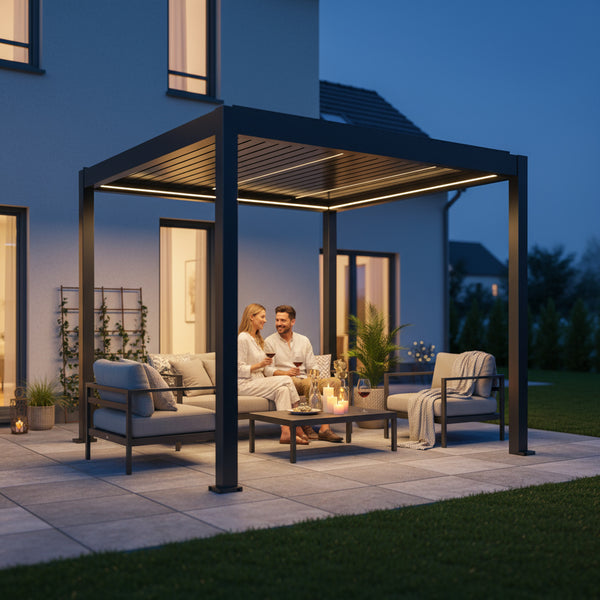
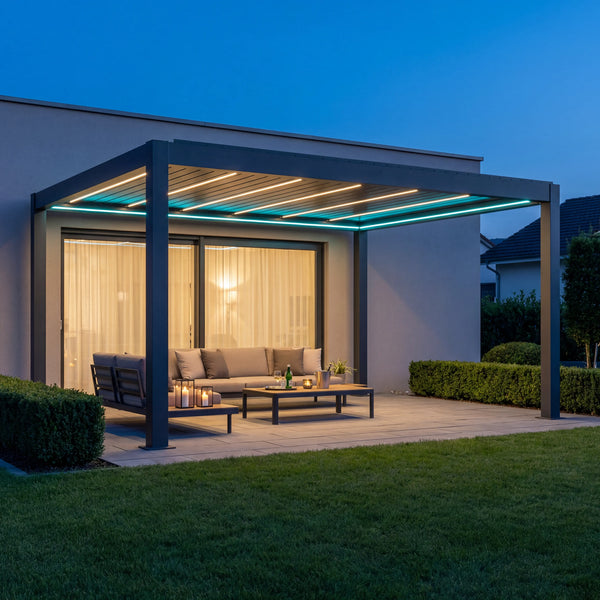
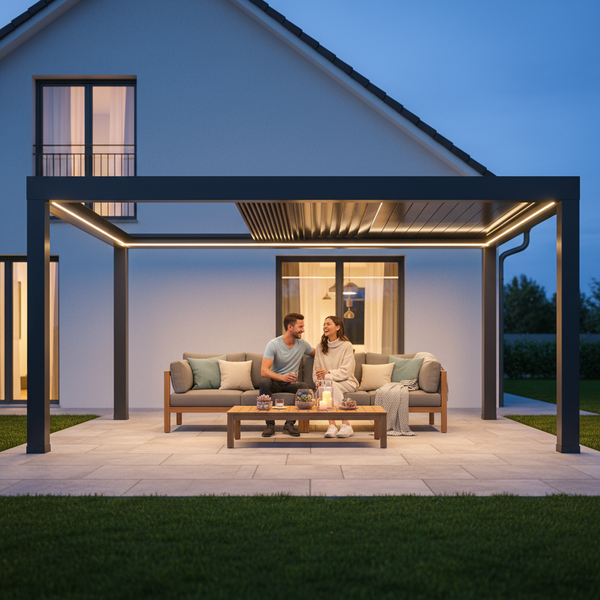
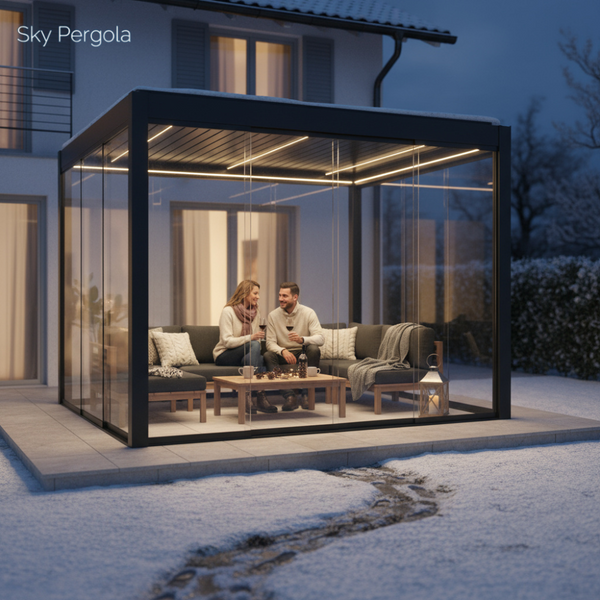
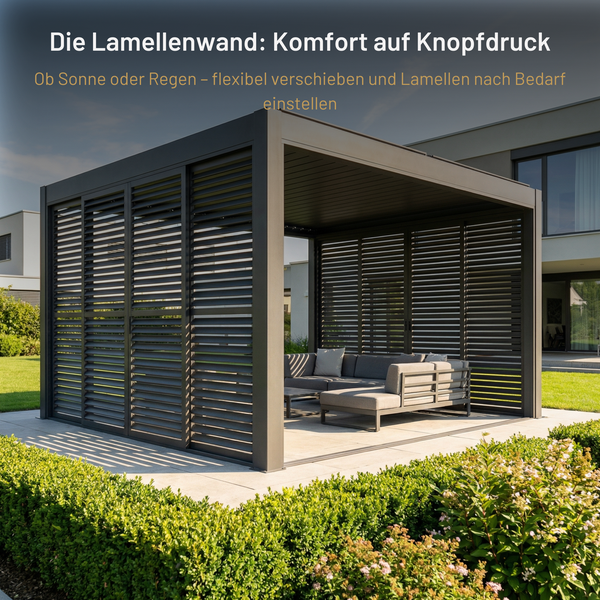
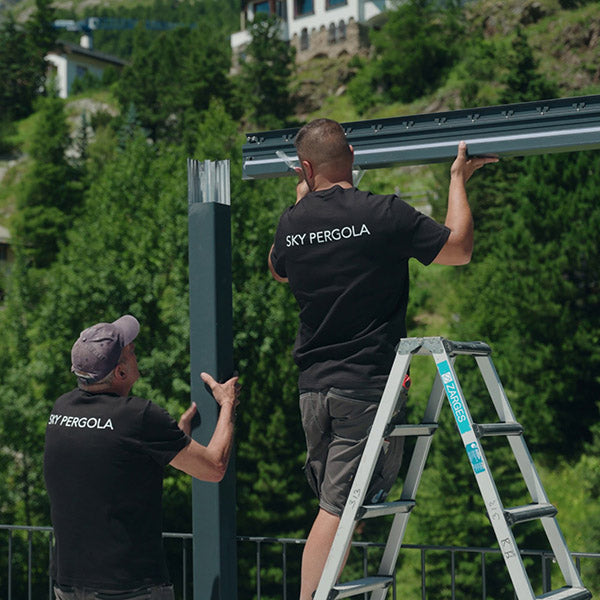
A construction with adjustable slats solves the same problem differently. The slats lie flat in summer and fully shade the area; in spring and autumn they can be opened so that the sun falls on the space again. This is the crucial difference to a rigid roof: shade is desired in August and not in April.
The price for this is the foundation. Such a construction needs point foundations, which must be planned before the surface. Anyone who sets the sandbox, paves the surroundings and only then thinks about the roof digs up the finished place again. The sequence is: define usage areas, mark load points, set foundations, then surface and equipment.
Planning play equipment and roof together
In practice, this means that two trades must talk early. Whoever supplies the play equipment knows the necessary safety distances, fall zones and platform heights — information that determines where a post must not stand. A play tower with a side slide needs two metres of free run-out in slide direction, and a swing beam requires double the chain length distance in front and back.
Those who want to read up can find a guide at Sanilu Garten that covers play equipment including standards and space requirements — useful before anything is ordered, because the fall zones determine possible post axes. How sandbox and play tower can be shaded specifically is shown by Sanilu in the article Shade for playground and sandbox.
A simple planning sequence
- Record sun position. Photograph on a clear day at 9, 13 and 17 o'clock. This shows which corner really needs shade.
- Mark play area. Lay out equipment including fall zones with string, not estimated on paper.
- Determine post axes. Only now is it clear where a support can stand without conflicting with the fall zone.
- Set foundations. Frost-proof, usually 80 centimetres deep, connected to later drainage.
- Surface and equipment. Last, so nothing has to be opened again.
What this achieves
The gain is not aesthetics, but usage time. A shaded play area is usable all afternoon on hot days, the sand stays cool enough, and the equipment ages more slowly because it is not constantly exposed to UV. There is also a side effect many underestimate: A covered area at the edge of the playground is the place from which parents can watch without sitting in the sun themselves. Only then does the garden become usable for both sides.
Anyone planning new should therefore not treat shading as an accessory to be added later, but as the element that determines the location of all others. It is the only thing in the garden that needs a foundation.


