



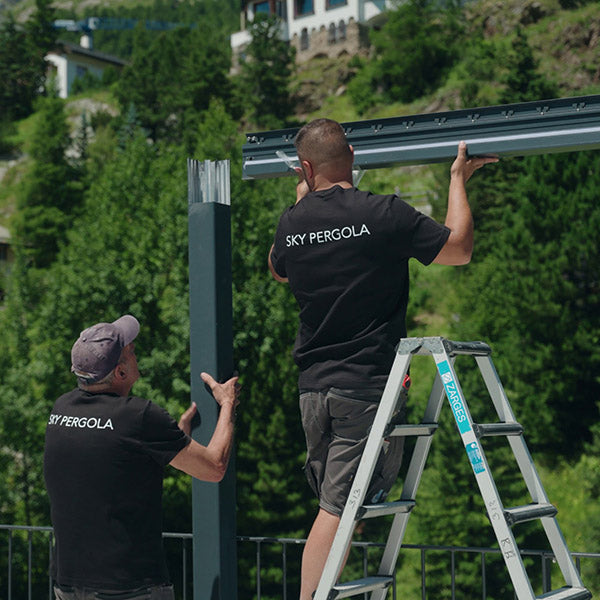
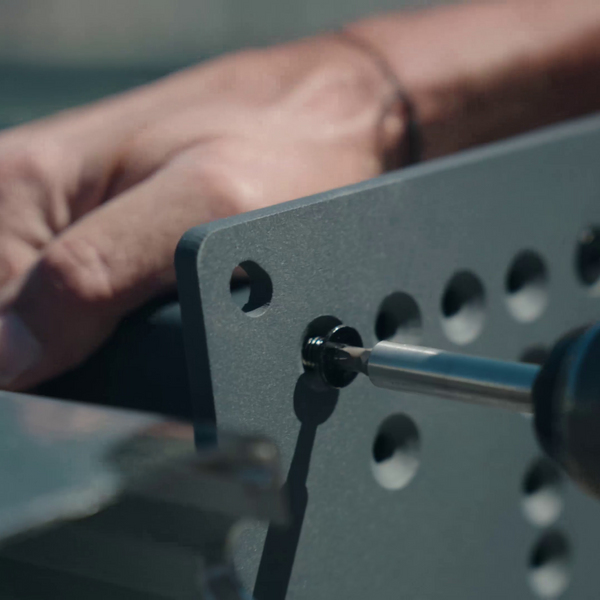

An electric pergola in Dubai lives or dies on one component you will probably never see: the drive that rotates the louvres. Everything else in the brochure stands still. The drive moves, several hundred times a season, in a climate that is hard on moving parts.
This guide is about that hardware only. Not scenes, not voice control: what physically turns the blades, why a wide roof needs more than one motor and how to see when they are out of step, what you do when the power drops out mid-evening, and what Gulf heat, airborne sand and coastal salt actually do to a motor housing, its seals and its end positions.
At the end you get a handover checklist you can run yourself in twenty minutes with the installer still on site, plus a care calendar for the October to April outdoor season. None of it requires tools or technical training, only that you ask to see things work before you sign off.
Key takeaways
- Two drive topologies do all the work in this category: a tubular motor turning a drive tube inside the louvre pack, or a linear actuator pushing a lever linkage that rotates every blade together. Sky Pergola's rotating louvre roofs use the actuator-and-linkage principle.
- One drive sets one angle for one field. A wide or multi-bay roof runs two or more drives that have to track each other, and skew is something you can see at handover from the shadow line along the seam.
- Unless the manufacturer states otherwise, a rotating electrical machine is only specified for an ambient air temperature up to 40 °C [1], while the mean daily maximum in Dubai in August is 41.9 °C [2]. That is the general standard for rotating machines, so treat the figure as a standard reference condition and ask for the drive's own stated temperature range in writing.
- What happens at a power cut is a supplier question, not an assumption: ask in writing whether the roof stays in the position it was in and what moves it afterwards.
- The manual override is the most-skipped item at handover. Ask what it is, where it sits, and have the installer move the roof with the drive isolated while you watch.
- The product standard for powered external blinds and awnings deliberately contains no noise requirement [3]. Every whisper-quiet claim is therefore unregulated language; if quietness matters next to a bedroom, agree a measured figure contractually.
- An IP rating belongs to the enclosure as tested, not to your installation: if enclosures are drilled or knockouts removed, measures must be taken to restore the original rating [4].
What actually moves the louvres of an electric pergola in Dubai
An electric pergola is sold on the remote control, but the remote only sends a signal. The work is done by a drive concealed in the beam, and in this product family there are only two ways it is built. Knowing which one is above your head tells you what to listen for, where the adjustments live, and what a service call will involve in five years.
The four parts of the drive
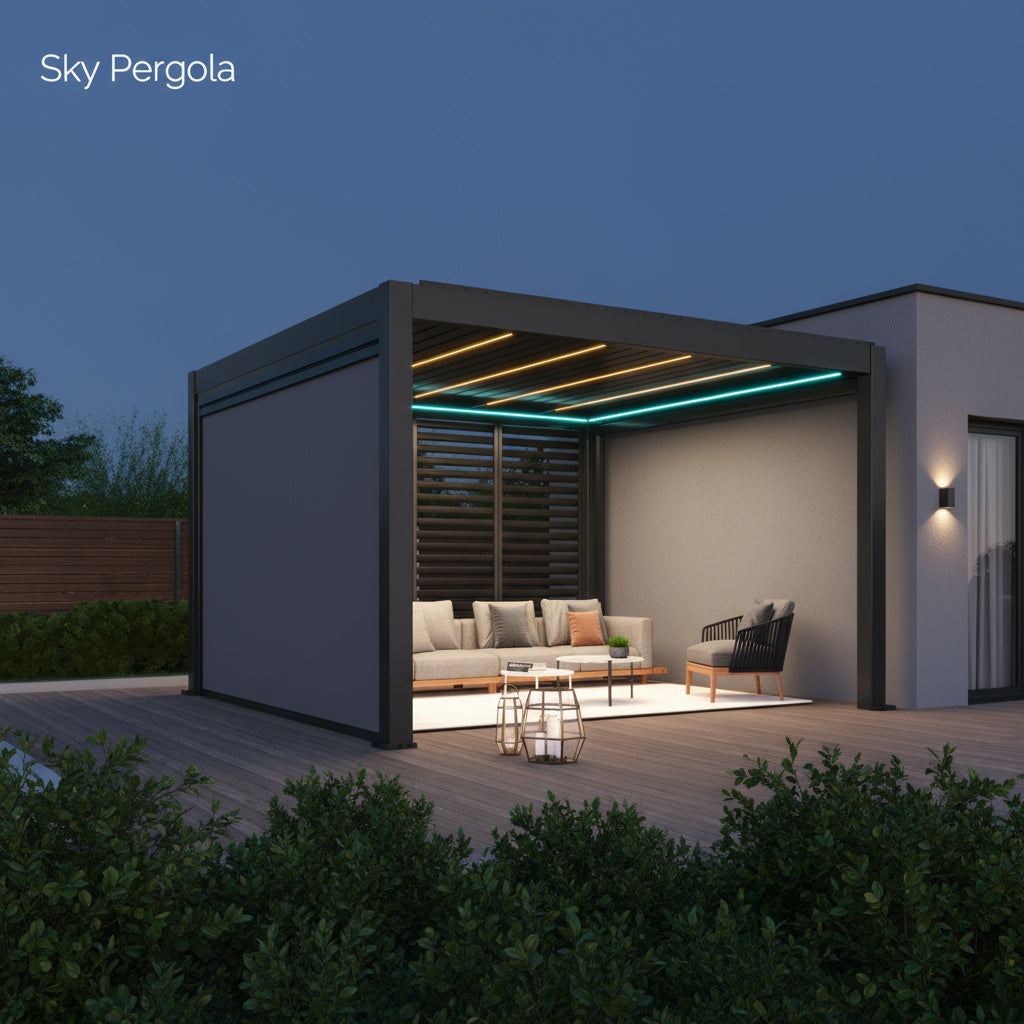
Every motorised louvre roof has the same four component groups. First, the blades, each carried on a bearing at both ends inside the side beams. Second, a mechanism that turns a single motion into the rotation of every blade at the same angle, either a drive tube running through the louvre pack or a lever linkage along one beam. Third, the motor with its gearbox and its end-position limits. Fourth, the wiring and the controller that takes your remote-control or wall-switch command. On Sky Pergola models the motor sits inside the beam and is not visible from underneath, and posts, beams and louvres all come in the same colour.
What happens when you press close
The controller energises the drive, the drive moves the tube or the linkage, and the blades rotate together until an end-position limit tells the controller the roof has arrived. That detail is worth sitting with: the blades stop because a limit says so, not because they have run into a hard stop. End positions are a setting, and settings can be set badly or drift. That is exactly why a roof which closed flush in year one can show a line of daylight along the blades in year three.
Tubular motor inside the louvre pack
Here the motor is a slim cylinder inside a tube and turns it, and the tube drives the blades through gears or crank arms. Because the motor is buried in the roof pack it is invisible and shielded from direct sun, but it is also the hardest component to reach: access usually means opening the roof assembly rather than a service cover. Ask where the service access is before you buy, not after a failure.
Linear actuator on a lever linkage
Here the motor drives a rod or spindle that extends and retracts, and that straight push is converted into rotation by a lever linkage running along the beam. Every blade is pinned to the same linkage bar, so the blades share one angle by mechanical necessity rather than by electronic coordination. Sky Pergola describes its roofs as driven by a linear actuator that rotates every louvre in unison, typically through roughly 0 to 135 degrees. Actuators are generally easier to exchange than a buried tube motor, and the linkage gives you something you can inspect: when a pin or bush wears, the slack is often visible.
How to tell which one you are being offered
Suppliers rarely state this, so ask directly and ask for a photograph of the drive bay on an installed roof.
| Aspect | Tubular motor in a drive tube | Linear actuator on a lever linkage |
|---|---|---|
| Where the drive sits | Inside the roof pack, concealed | Along or inside the beam, concealed |
| How blades share an angle | Through the tube, gears or crank arms | Through a common linkage bar, mechanically coupled |
| What you can inspect from below | Little without opening the roof | Linkage pins, bushes and rod travel, often visible from a ladder |
| Service access | Usually needs the roof assembly opened | Usually the easier unit to exchange |
| What wear tends to sound like | A hum with no travel, or a change in pitch | A knock or click at direction change as pins develop play |
| What to ask the supplier | Where the service access point is and how an exchange is done | Pin and bush material, and whether bushes are replaceable individually |
Why a wide roof needs more than one drive
One drive, one field, one angle
A single drive rotates the blades of the field it is connected to. Divide a roof with an intermediate beam, because the span is long, because the shape is L-formed, or because a post had to land in a particular place, and you now have two louvre packs, two linkages and, in almost every case, two drives. The same applies when a terrace is covered by two units side by side, which is common on villa plots where one structure would be too wide to span.
That is not a defect, it is how large roofs are built. What matters is that two drives introduce a failure mode a single drive does not have: they can end up out of step.
How synchronisation is actually achieved
There are two honest answers, and you want to know which applies to your roof. Either the fields are mechanically coupled, with one drive and a shaft or coupling carrying the motion across the beam into the second linkage, or each field has its own drive and the controller runs them together, matching start, speed and end position electronically. Mechanical coupling cannot drift but limits the layout. Separate drives are flexible, but their end positions are two independent settings, and the day one of them is adjusted alone, the fields stop arriving together.
Get one sentence onto the handover sheet: how many drives does my roof have, and how are they kept in step. A vague answer is an open point, not a detail.
Seeing skew with your own eyes
You need no instruments. Stand underneath, run the roof fully closed, and look along the seam between the fields with the sun high: a bright line of daylight on one side of the beam and none on the other means the fields are not at the same angle. Then run a full open and a full close while watching both fields. If one arrives a noticeable moment before the other and the second keeps travelling, that is skew. Repeat three times. A roof that lands identically three times running has repeatable end positions; one that lands differently each time does not, and that is a commissioning job to finish before handover rather than a quirk to live with.
When the power goes out: manual operation and emergency release
This is the question buyers ask most and brochures answer least. Whether your roof holds its position when the power drops depends on the gearbox and the brake of the drive, so have the supplier put in writing what happens during a power cut and whether the roof stays in the position it was in. Plan for the practical problem either way: being stuck open when a winter shower arrives, or closed on a pleasant evening when you wanted the sky.
What a manual override actually is
In this product family there are four possibilities, and only the supplier can tell you which you have: a mechanical crank or hex-key engagement that lets you drive the mechanism by hand; a declutch that disengages the gearbox so the linkage can be moved; a battery or uninterruptible supply that keeps controller and drive alive for a run or two; or nothing at all, in which case the roof waits for the power to come back. All four are legitimate engineering choices. Leaving the question unanswered is not.
The questions that get you a straight answer
- What does the roof do at the moment the supply fails, and does it stay in the position it was in? Ask for that answer in writing.
- Which of the four overrides does my roof have, and on which beam or post is the access point?
- If it is a key or crank: how many are supplied, where should they live, and can replacements be ordered?
- How long does a full manual run take, and is there a limit on how often the override may be used?
- Does moving the roof by hand affect the end-position settings, and if so, who resets them?
- Is the drive assessed to the dedicated safety standard for drives for rolling shutters, awnings, blinds and similar equipment, whose current edition 4.0 was published on 15 December 2023 and covers drives rated up to 250 V for single-phase products, including DC and battery-operated drives [5]?
A two-minute drill, twice a season
An override you have never used is a theory. Do this at handover with the installer present, then once in October and once in February: switch the drive off at its isolator, take the key or crank from where it is stored, move the roof by hand through a short travel in both directions, return it, restore power, and run one full powered cycle to confirm the roof still finds both end positions. Two minutes. The first time you need it in a real power cut, you will not be reading a manual by phone torchlight.
Gulf heat is a specification problem, not a comfort topic
The 40 °C default nobody mentions
Unless the manufacturer specifies otherwise, a rotating electrical machine is only suitable for an ambient air temperature up to 40 °C, and a hotter site is a deviating condition that calls for a correction to the rating [1]. Put that beside the climate: the WMO normals for 1991 to 2020 at Dubai International Airport give a mean daily maximum of 41.9 °C in August, 24.4 °C in January and an annual mean maximum of 34.0 °C [2]. The average August afternoon is already past the default rating. Air temperature is also only the lower bound for the drive, because a concealed housing inside a sun-struck aluminium beam runs hotter than the air around it.
One qualification keeps this honest. IEC 60034-1 is the general standard for rotating electrical machines [1], while drives for rolling shutters, awnings and blinds have their own standard, IEC 60335-2-97 [5]. Take the 40 °C as a standard reference condition rather than as the limit of your particular drive, and precisely for that reason ask for the component's temperature range in writing.
This is not an argument against a motor. It is an argument for one line in your quotation: the stated ambient temperature range of the drive, taken from the component manufacturer. A supplier who sells in the Gulf should have it to hand.
Periodic duty: the drive is not built to run all day
Drives of this kind are often rated for periodic rather than continuous duty. Where that is the case and nothing else is specified, the standard default is a duty cycle of 10 minutes with a cyclic duration factor of 15, 25, 40 or 60 per cent [6], which in plain terms means the motor is designed to run for a fraction of each cycle and rest for the remainder. That suits a roof which travels for under a minute a few times a day, and suits badly the demonstration habit of cycling a roof back and forth ten times on a hot afternoon. If travel stops mid-run on a 42 °C day and works again half an hour later, a thermal cut-out doing its job is the likeliest explanation, not a broken motor. Ask whether the drive has thermal protection and how it resets, so you can recognise it rather than report it as a fault.
Thermal expansion and blades that bind
Alloy 6063, the standard alloy for architectural extrusions, expands by 23.4 micrometres per metre per °C over the range 20 to 100 °C [7]. Work that through for a long blade: 6 m of length, a 30 °C swing between a cool morning and a hot afternoon, so 6 × 30 × 23.4 micrometres, which is about 4.2 mm of growth in one blade. That movement has to go somewhere. A roof built with the right end clearances absorbs it silently; one assembled tight will creak, rattle or bind at the hottest hour and then behave perfectly at 7 a.m. If your roof only misbehaves in the afternoon, say exactly that to the technician, because the time of day is half the diagnosis.
Sand, dust and salt air: the parts that fail first
Bearings, linkage pins and end-position sensors
Most pages treat dust as a cleaning topic for the roof surface. For the drive it is an abrasion topic. Fine, hard, wind-carried sand settles into precisely the places that have to move: the blade bearings in the side beams, the pins and bushes of the linkage, the gap around the actuator rod, and the end-position sensors that decide where closed is. Grit in a bearing raises the load the drive has to overcome, which the motor pays for in current and heat. Grit on a limit or sensor target changes where the roof believes it has arrived, and that is one of the real causes behind louvres that no longer close flush.
The remedy is unglamorous: rinse the louvres and the visible bearing ends with water and dry them, look at the linkage for a dry, dull appearance rather than a lubricated one, and have the drive bay inspected on a stated interval rather than when something squeals. Do not spray lubricant into a bearing on your own initiative; ask the supplier what, if anything, their mechanism wants.
Coastal chlorides and the parts rain never washes
Aluminium does not rust, which is true and routinely oversold. ISO 9223 grades atmospheric corrosivity in six categories — C1 to C5 plus the extreme category CX, which is defined specifically for marine and marine or industrial environments [8] — and its own example list for category C5, very high, includes coastal areas and sheltered positions on a coastline in temperate and subtropical zones where chlorides have a significant effect [9]. The numbers are not zero either: in category C5 the first-year corrosion rate of aluminium runs from over 5 up to 10 g per square metre per year, and above 10 g per square metre per year the environment counts as CX [10].
Then comes the part that matters for a pergola drive. Surfaces that are sheltered and not rain-washed in marine atmospheres can experience a higher corrosivity category than exposed ones, because deposited chlorides accumulate and are never rinsed off [11]. And because sea salt is hygroscopic, those sheltered surfaces stay wet substantially longer, which lengthens the time corrosion can proceed [12]. Read that as a map of your roof: the louvre bearings, the linkage pins and the motor housing tucked under the beam are the worst-placed components on the whole structure, precisely because they are protected from rain. On a coastal plot, that is where a service visit should be looking.
Where a component is anodised rather than powder-coated, the thickness class is the durability specification. ISO 7599 grades anodic coatings as AA 5, AA 10, AA 15, AA 20 and AA 25, where the number is the minimum average thickness in micrometres and the minimum local thickness is 80 per cent of it [13], and the standard states that protection against pitting corrosion rises with coating thickness, so product life time is very dependent on it [14]. Ask which class, not whether it is treated.
Why the annual rainfall will not clean anything for you
Dubai records 79.2 mm of rain in a normal year at the airport station, almost all of it between October and April [2]. In a temperate climate you can half-rely on rain to wash salt and dust off a structure. Here you cannot, and the drive components are sheltered from the little rain there is. Every cleaning cycle your pergola gets, you or your supplier will have to perform deliberately. That single fact is why the care calendar below exists.
IP ratings, cable routing and the hole drilled in your post
What an IP number says, and what it does not
The IP code is defined in IEC 60529 as a coding system covering three things at once: protection of people against access to hazardous parts, ingress of solid foreign objects, and ingress of water [15]. The current consolidated edition 2.2 is dated 29 August 2013 and applies to enclosures for electrical equipment with a rated voltage not exceeding 72.5 kV [16]. For a dusty environment that gets hosed down occasionally, the digits are summarised cleanly in the Abu Dhabi Department of Energy wiring regulations: first digit 5 means limited protection against dust, to the extent that it does not harm the equipment or impair safety, while 6 means totally protected against dust; second digit 5 means low-pressure jets of water from any direction, and 6 means strong jets from any direction [17]. Those are regulations for the Emirate of Abu Dhabi, not Dubai, so the IP digits travel but the electrical rules do not. Have the electrical side of your installation checked on site by someone competent for your emirate.
Two limitations are more useful than the number itself. The code says nothing about protection against humidity or corrosive gases, and if enclosures are drilled or knockouts removed, suitable measures should be taken to restore the equipment to its original IP rating [4]. So an impressive IP label is no statement whatever about coastal salt air, and it describes the enclosure as tested rather than the enclosure as installed in your garden.
The cable entry is where the rating is won or lost
Cables for a pergola drive are normally routed inside the frame, down through the beam and the post, out of sight and out of the sun. That is the right way to do it, and it means somebody makes holes: into the beam, through the post, and through the wall of a control enclosure. Each penetration is a potential path for water running down the inside of a post and for wind-driven sand.
At handover, look at every entry you can see and ask three things: what seals this penetration, is the seal a proper cable gland or a bead of silicone, and who re-seals it if the drive is ever exchanged. Silicone in Gulf sun is a maintenance item, not a solution. Add one more question at the post base: where does water that gets inside the frame leave again? Sky Pergola models drain rainwater through the posts by design, and that path has to stay clear of dust and debris to keep working. The closed roof is rainproof rather than sealed like a bathroom; in an extreme storm the construction means water can occasionally find its way in, which is why the drainage route matters more than any promise.
Running noise, travel time and the wind figure you are owed
No standard requires your roof to be quiet
Start here, because it reframes every quiet and silent claim in the market. EN 13561, the European performance standard for external blinds and awnings, states that the noise emission of power-operated external blinds and awnings is not considered a relevant hazard and that the standard therefore contains no specific requirement on noise [3]. Conformity to that standard tells you nothing about how loud a drive is. Noise is a contractual matter, not a certified one. That cuts both ways, including for us: where you read that a roof runs quietly, including on our own pages, you are reading a manufacturer description without a measured value behind it.
So if the pergola sits against a bedroom wall or over the majlis, treat it as a negotiated specification: ask for a measured sound pressure level at a stated distance, with the distance and the operating state written down, and have it put in the quotation. A supplier who cannot provide a figure can at least let you stand under a running installation and listen, which is worth more than an adjective.
Reference points for a bedroom wall
There is no product limit to point at, but there are health-based reference points. The WHO night noise guidelines for Europe identify 40 dB Lnight,outside as the lowest observed adverse effect level, above which self-reported sleep disturbance, environmental insomnia and increased use of sleeping pills and sedatives are observed [18], while below 30 dB Lnight,outside no effects on sleep were observed apart from a slight increase in body movements [19]. Those are night-time environmental guidelines for the WHO European Region, averaged over a night, not limits for a product that runs for well under a minute. Use them to calibrate your expectations: a drive you can hear through a closed bedroom window is one you will stop using after 10 p.m., whatever the datasheet says.
Time the run and write the number down
Nobody publishes travel times, so make your own record. At handover, with a phone stopwatch, time a full closed-to-open run and a full open-to-closed run, and have both numbers written on the handover sheet with the date. The figures themselves are not the point; the baseline is. When the same run takes noticeably longer in two years, you have objective evidence of added friction in the bearings or the linkage, which turns a vague it seems slower into a service request somebody can act on.
The wind speed your supplier should state
For the external blind and awning family, EN 13561 grades wind resistance in seven classes by nominal wind pressure, from under 40 N/m² in class 0 up to 400 N/m² in class 6, with a separate safety wind pressure listed for each class [20], and classes 4 to 6 may only be claimed for pergola awnings and for blinds whose fabric runs in lateral guide rails, while a folding-arm awning may never exceed class 2 [21]. More useful still, the manufacturer is obliged to define a maximum wind speed above which the product must be retracted and to state that speed in the instructions for use [22]. That is the shape of answer to expect for any powered external element: a number in the manual, not an adjective in the brochure.
Two honest caveats. EN 13561 is a European product standard for blinds and awnings, not UAE law and not a standard for a rotating aluminium louvre roof, so treat it as specification language you can demand rather than a rule binding anyone here. And it expressly does not cover the structural part to which a pergola awning is fixed [23], so the supporting structure is always a separate verification. For the structures themselves, Sky Pergola states wind resistance of up to 120 km/h for the SkyMotion LED, SkyMax Ultra and SkyLite ECO, up to 150 km/h for the SkyInfinity Pro and up to 200 km/h for the SkyGrand Master. Ask us which figure applies to your configuration and site.
How this maps onto the Sky Pergola range
Motorised louvre roofs
Our rotating louvre roofs work on the actuator-and-linkage principle described above, with the drive concealed inside the beam and the louvres rotating in unison. The SkyMotion LED aluminium pergola is the compact motorised model at 3 x 3 m with integrated LED and a motorised louvred roof, from AED 28,755. The SkyMax Ultra aluminium pergola covers 4 x 6 m with illuminated louvres and motorised operation, from AED 49,455, and at that width the questions about field division and synchronisation are the ones to raise at quotation stage.
The SkyInfinity Pro aluminium pergola is a different roof task again: its louvred roof is fully retractable and opens up to 70 per cent, in sizes 3x3, 3x4, 3x6, 4x4, 4x5 and 4x6 m, from AED 62,055. Retracting a pack and rotating a blade are not the same mechanical problem, and the retractable pergola page for Dubai sets out how that roof type behaves.
For background on the rotating roof itself rather than its drive, the louvre roof pergola page for Dubai covers angles and shade behaviour, the motorised pergola page covers the comfort side, and the electric pergola collection lists the models with a powered roof side by side.
The honest case for a manual roof
A motor you do not have cannot fail, cannot overheat at 42 °C and cannot lose its end positions. The SkyLite ECO aluminium pergola is 3 x 3 m with integrated LED and a manual louvred roof, from AED 21,555. For a small seating area adjusted twice a day by someone who is there anyway, that is a defensible choice rather than a downgrade. The trade comes due on the days you are away, at the top of a roof-terrace stair, or when the angle wants changing four times between lunch and sunset. Decide it on how you actually use the space.
Handover and aftercare: what to witness, what to get in writing
Ten things to witness before you sign off
- A full travel in both directions, fully closed to fully open and back, without interruption.
- Three consecutive full closes that land in the same place, so you have end-position repeatability rather than one lucky run.
- With the sun high, no daylight line along the closed blades.
- On a multi-field roof, both fields arriving together, with the installer stating how many drives there are and how they stay in step.
- Both run times measured with a stopwatch and written on the handover sheet with the date.
- The manual override demonstrated with the drive isolated, by the installer, and then operated once by you.
- Every key, crank or tool for the override handed over and counted, with a note of where replacements are ordered.
- Every visible cable penetration in beam, post and control enclosure inspected, and what seals it stated.
- The drainage path through the posts shown to you, including where water leaves at the bottom and how you check it is clear.
- The drive's stated ambient temperature range and IP rating read out from the component documentation, not described in adjectives.
What belongs in writing
- What the roof does when the supply fails, and whether it stays in the position it was in.
- Which drive components are covered and for how long, stated separately from the structure. Sky Pergola states a 10-year warranty on the aluminium structure on its Dubai pages; the drive is a different component with its own terms, so ask for them explicitly.
- Spare-part availability for the drive, the controller, the remote control and the linkage pins and bushes, and how a replacement is ordered.
- The service interval recommended for your site, with coastal plots treated differently from inland ones, and what a service visit includes.
- Response time for a roof stuck in the open position during the rainy months, as distinct from a cosmetic fault.
- The maximum wind speed at which the roof should be closed or opened, and who adjusts that setting if your site is exposed.
- Whether using the manual override affects end-position settings, and whether resetting them is a chargeable visit.
Care calendar for the October to April season
Almost all of Dubai's 79.2 mm of annual rain falls between October and April [2], which is also when the terrace is in use. The plan below is deliberately boring. It exists because nothing on a pergola drive cleans itself.
| When | What you do | What you are watching for |
|---|---|---|
| Early October, season start | Three full cycles, time one run, rinse louvres and visible bearing ends and dry them, run the override drill | Run time against last season's figure, new noises, any daylight line when closed |
| Monthly, October to April | Rinse the louvres, look along the closed roof from below, check the drain outlets at the post bases | Grit around bearings, slack or knocking in the linkage, a blocked drain |
| After a dust or sand event | Rinse rather than brush, especially at the beam ends where the bearings sit | Sand collecting in bearing gaps and around the actuator rod |
| After rain | Open the louvres once the shower passes so trapped water can dry, and check the drain path | Standing water on blades, staining inside a post, slow drainage |
| February, mid-season | The skew check with the sun high, repeated three times, plus a second override drill | Fields drifting out of step, end positions no longer repeating |
| March, before the heat | Book the service visit, confirm spare-part availability, agree the summer rest position | Everything you logged during the season, now with a technician present |
| April to September, out of season | One full powered cycle a month, and a rinse after sandstorms | A drive that has not moved in months, seals drying out, grit bedded into a bearing |
The bottom line
An electric pergola is a sound buy in Dubai, and the drive is the part that decides whether you still like it in year five. Nothing here asks you to become an engineer. It asks you to get four things on paper: the drive type and its service access; the number of drives and how they stay in step; the drive's ambient temperature range and IP rating; the manual override, with a live demonstration. Then run one twenty-minute handover before the final payment leaves your account.
If you are still choosing, choose on what can be inspected and written down rather than on which brochure says smart most often. Put your size, location and layout into the Sky Pergola configurator to see which models fit your space, and ask us the drive questions from this article directly. A supplier who answers them specifically is the one to deal with, here or anywhere.
Frequently asked questions
What happens to my pergola louvres during a power cut in Dubai?
Treat that as a supplier question rather than an assumption. Whether the roof holds the position it was in when the supply fails depends on the gearbox and the brake of the drive, so have the supplier state in writing what happens during a power cut and whether the roof stays where it is. Plan for the practical side either way: you may be stuck open as a winter shower arrives, or closed on a fine evening. Whether you can move it by hand depends entirely on which override your drive has, so ask that question before you buy.
Is the manual override a hand crank, a hex key or a battery backup, and should I test it?
It is one of four things: a crank or hex-key engagement, a declutch, a battery or uninterruptible supply for a run or two, or nothing at all. Only your supplier can say which. Test it at handover with the drive isolated, then twice a season. Also ask whether hand operation disturbs the end-position settings and who resets them if it does.
Why do the louvres on one bay close before the other on a wide pergola?
Because a wide or L-shaped roof is divided into fields, and each field usually has its own drive. If the drives are coordinated by the controller rather than coupled mechanically, their end positions are two separate settings and can drift apart. Close the roof at midday and look along the seam: daylight on one side of the beam and not the other is skew, and it is a commissioning correction rather than something to accept.
Can a pergola motor cope with UAE summer temperatures?
Only if it is specified for it. Unless the manufacturer states otherwise, a rotating electrical machine is suitable for ambient air up to 40 °C under IEC 60034-1[1], while the WMO climatological normals 1991 to 2020 for Dubai International Airport give a mean daily maximum of 41.9 °C in August[2]. IEC 60034-1 is the general standard for rotating machines, and drives for rolling shutters, awnings and blinds have their own standard, IEC 60335-2-97[5], so take 40 °C as a standard reference condition rather than the limit of your drive. A concealed housing in a sunlit beam also runs hotter than the air. Ask for the drive's stated temperature range from the component manufacturer, in writing.
How loud is a motorised pergola roof next to a bedroom?
Nobody is obliged to tell you. EN 13561, the European product standard for powered external blinds and awnings, treats noise as not a relevant hazard and sets no requirement for it[3], so quiet is marketing language unless a measured figure is agreed. For calibration, the WHO night noise guidelines for Europe put 40 dB Lnight,outside as the lowest observed adverse effect level[18]. If the roof is near a bedroom, ask to hear one running and put a figure in the contract.
What IP rating should the motor, control box and cable entries have?
Ask for the digits rather than a label. In the Abu Dhabi Department of Energy wiring regulations, first digit 5 means limited protection against dust and 6 means totally dust-tight; second digit 5 means low-pressure water jets from any direction and 6 means strong jets[17]. Remember the limits: the code says nothing about humidity or corrosive gases, and drilling an enclosure means measures must be taken to restore the original rating[4]. Those are rules for the Emirate of Abu Dhabi, so have the electrical side checked by someone competent for your own emirate, and inspect how each cable entry is sealed.
How often should a motorised pergola be cleaned and serviced in the UAE?
More often than the brochures suggest, because rain will not help. The WMO normals 1991 to 2020 for Dubai International Airport give 79.2 mm of rain in a normal year, almost all of it October to April[2], and the drive parts are sheltered from it anyway. Rinse the louvres and bearing ends monthly through the season and after each dust event, cycle the roof monthly in summer, and agree a documented annual service with your supplier, with coastal sites inspected more closely.
Should I buy manual louvres instead and avoid the motor altogether?
It is a fair option for a small, frequently occupied terrace. A manual roof has no motor to overheat, no end positions to drift and no drive to service. The SkyLite ECO is 3 x 3 m with a manual louvred roof, from AED 21,555. The cost is convenience: every angle change is a trip to the pergola, which becomes tiring if you adjust shade several times a day or the pergola sits up a stair.
Sources
- IS/IEC 60034-1 (2004): Rotating electrical machines — Part 1: Rating and performance, Clauses 6.1 and 6.3 – Bureau of Indian Standards / International Electrotechnical Commission (IEC)
- WMO Climatological Normals 1991–2020, Dubai International Airport (WMO 41194) – World Meteorological Organization (WMO) / National Center of Meteorology (UAE), archived by NOAA National Centers for Environmental Information
- EN 13561:2015 — External blinds and awnings — Performance requirements including safety, Clause 1 Scope – European Committee for Standardization (CEN)
- The Electricity Wiring Regulations (2020), Appendix A10 — IP coding for ingress protection – Department of Energy (DoE), Abu Dhabi
- IEC 60335-2-97:2023 — Household and similar electrical appliances — Safety — Part 2-97: Particular requirements for drives for rolling shutters, awnings, blinds and similar equipment – International Electrotechnical Commission (IEC)
- IS/IEC 60034-1 (2004): Rotating electrical machines — Part 1: Rating and performance, Clause 5.2.3 Rating for periodic duty – Bureau of Indian Standards / International Electrotechnical Commission (IEC)
- Aluminium / Aluminum 6063 Alloy (UNS A96063) – AZoM.com (AZoNetwork), published 27 September 2012
- ISO 9223:2012 — Corrosion of metals and alloys — Corrosivity of atmospheres — Classification, determination and estimation – International Organization for Standardization (ISO)
- ISO 9223:2012, Annex C, Table C.1 — Description of typical atmospheric environments related to the estimation of corrosivity categories – International Organization for Standardization (ISO)
- ISO 9223:2012, Table 2 — Corrosion rates for the first year of exposure for the different corrosivity categories – International Organization for Standardization (ISO)
- ISO 9223:2012, Annex C, Table C.1, NOTE 4 – International Organization for Standardization (ISO)
- ISO 9223:2012, Annex B, Table B.1, NOTE 2 — Time of wetness in different exposure conditions – International Organization for Standardization (ISO)
- ISO 7599:2010 — Anodizing of aluminium and its alloys — General specifications for anodic oxidation coatings on aluminium, Clause 6.2 and Table 1 – International Organization for Standardization (ISO)
- ISO 7599:2010 — Anodizing of aluminium and its alloys — General specifications for anodic oxidation coatings on aluminium, Clause 6.2 – International Organization for Standardization (ISO)
- IEC 60529:1989+A1:1999 — Degrees of protection provided by enclosures (IP Code), Clause 3.4 – International Electrotechnical Commission (IEC)
- IEC 60529:1989/AMD2:2013 CSV — Degrees of protection provided by enclosures (IP Code) – International Electrotechnical Commission (IEC)
- The Electricity Wiring Regulations (2020), Appendix A10 — IP coding for ingress protection – Department of Energy (DoE), Abu Dhabi
- Night Noise Guidelines for Europe (2009), Executive Summary — Recommendations for health protection – World Health Organization, Regional Office for Europe
- Night Noise Guidelines for Europe (2009), Executive Summary — Recommendations for health protection – World Health Organization, Regional Office for Europe
- EN 13561:2015 — External blinds and awnings — Performance requirements including safety, Table 1 — Classes of wind resistance – European Committee for Standardization (CEN)
- EN 13561:2015 — External blinds and awnings — Performance requirements including safety, Clause 4.1 – European Committee for Standardization (CEN)
- EN 13561:2015 — External blinds and awnings — Performance requirements including safety, Clause 4.1 – European Committee for Standardization (CEN)
- EN 13561:2015 — External blinds and awnings — Performance requirements including safety, Clause 1 Scope – European Committee for Standardization (CEN)
Last updated: October 2026


